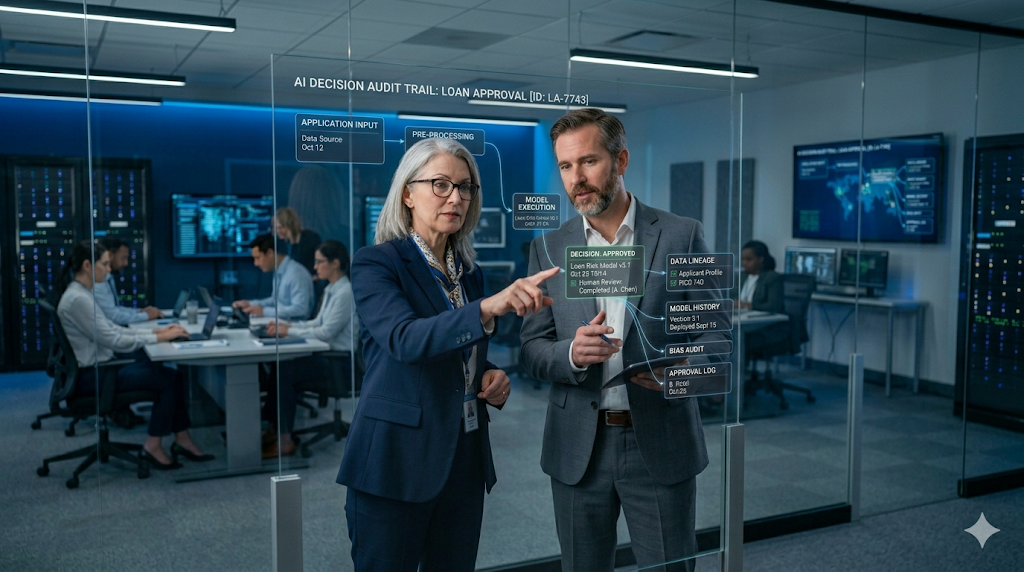
AI is now involved in many everyday business decisions — whether it’s approving a loan, prioritizing a service request, or identifying suspicious activity. The challenge isn’t using AI anymore. It’s being able to trace a decision back to the data, logic, and processes behind it.
The Problem: AI Is Making Decisions Nobody Can Fully Explain
Most organizations already know how important record-keeping is in traditional business processes. If a loan is denied, a payment is blocked, or a claim is rejected, there is usually a way to go back and understand what happened.
With AI, that level of traceability is often missing.
Even after an AI model has been deployed and its outputs have become part of day-to-day business operations, many organizations struggle to explain how a specific decision was reached when regulators, auditors, customers, or internal stakeholders start asking questions like:
- What data was used?
- Which version of the model generated the result?
- Were there any changes to the logic or inputs at the time?
Those questions tend to surface only after something goes wrong, or someone needs proof that the process was working as intended.
The model is doing exactly what it was designed to do. The difficulty lies in proving how a specific decision was made — because the supporting records, lineage, and governance mechanisms were never put into place.
We’ve seen this across many enterprises we work with. The models are in production, the outcomes look promising, and the business moves forward confidently — but only until a regulator or customer poses a query or needs an explanation that the organization struggles to provide.
What This Costs You When It Catches Up
Regulators across financial services, healthcare, and other industries are asking a simple question:
“If AI helped make a decision that affected someone, can you explain how that decision was made?”
In the EU, the US, and several Asian markets, this is becoming a legal requirement. If you cannot explain, it is a business risk.
The impact goes beyond regulation. When an AI system starts giving unexpected results, teams need to understand what changed. But if they never had a clear record of how the system works — or was working at that time — finding the cause can take weeks and still leave many unanswered questions. Fixing the issue often becomes a matter of trial and error.
And when a decision is found to be wrong later, it can be difficult to determine who is responsible within the organization. That lack of clarity rarely helps — in most cases, it only makes the situation harder to manage.
What Actually Needs to Change
The solution is not to add more software on top of the AI systems you already have. The real change is building accountability into AI from the beginning. In practice, that means a few things.
First, every AI-driven decision should have a clear record showing what data was used, which version of the model made the decision, and what factors led to the outcome.
Second, there should be clear guidelines on when a person needs to review a decision before action is taken, along with a record showing that those checks happened.
Third, organizations need to monitor how AI behaves over time, not just whether the system is running. As conditions change, AI can start behaving differently, and teams need visibility into those shifts.
Finally, because AI decisions often involve data and processes spread across multiple systems, the record of what happened needs to cover the entire process, not just one application.
None of this is complicated. It is simply good engineering practice applied to AI. The difference is that it has to be built in from the start, not added later when problems begin to appear.
Why Parkar Has Solved This Before
Parkar has worked with enterprises in financial services, healthcare, and industrials who faced this exact problem: AI running in production, regulators beginning to ask questions, and no defensible paper trail behind the decisions.
What we have learned doing that work is that the organizations that get into trouble are almost always the ones that treated governance as something to be added later. It never gets added later at the right level.
The organizations that hold up under scrutiny are the ones that built accountability into their AI architecture from the beginning — not after the first incident, but before the model goes live.
Parkar is the AI Transformation Provider for the enterprise. AIONIQ is our framework — delivered through Discovery, Roadmap, Build, and Scale, supported by the AIONIQ Platform and Vector.
Governance and accountability are not a separate workstream inside AIONIQ; they are embedded from the first day of a Discovery engagement. By the time a client moves into Build, the infrastructure to explain every AI decision is already in place. We do not treat auditability as a feature — we treat it as a condition of deployment.
Start With an AIONIQ Discovery
If your organization is running AI today and is not certain it could answer a regulator’s questions about those decisions, that is worth addressing now rather than under pressure.
The AIONIQ Discovery is a five-day diagnostic that shows you exactly where your AI governance stands, what is missing, and what it takes to get to a position you can defend.
Start With an AIONIQ Discovery
A five-day diagnostic that shows exactly where your AI governance stands, what's missing, and what it takes to reach a position you can defend.