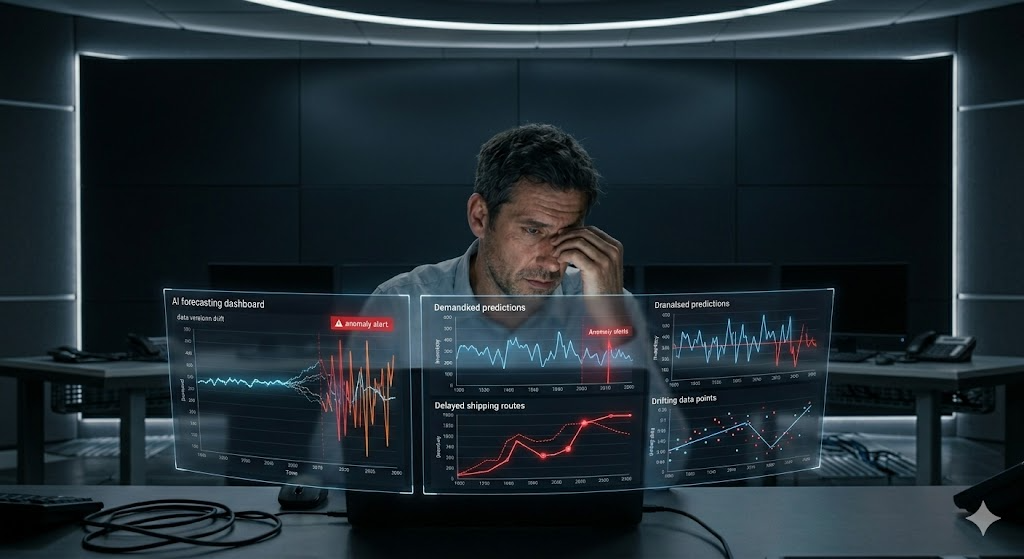
72% of companies reported a negative impact on their supply chains during COVID-19, according to a 2020 EY survey. But behind the headlines about factory shutdowns and logistics chaos was a quieter failure: forecasting models, AI and traditional alike, collapsed the moment the data underneath them stopped reflecting reality.
That is data version drift in action. And if your supply chain relies on AI for demand forecasting, inventory planning, or procurement decisions, it is a risk you cannot afford to overlook.
What Exactly Is Data Version Drift?
Think of your AI forecasting model as a very smart employee who studied everything about your business buying patterns, seasonal demand, and customer behaviour, then got locked in a room with no new information.
Everything outside the room changed. A port shut down, raw material spiked, and a new product line launched. Consumer preferences shifted overnight, but the model keeps recommending decisions based on the world it last saw, not the world you are operating in today.
That gap between the data your model was trained on and the data flowing into it right now is data version drift.
COVID Made This Impossible to Ignore
Before 2020, many supply chain teams treated this as a theoretical risk. Then the pandemic hit, and theoretical became catastrophic.
AI models trained on stable demand patterns suddenly faced panic buying, factory shutdowns, and unpredictable customer behaviour. As a result, companies ended up overstocking unwanted products and running out of essential ones because the data had changed.
Companies that adapted their forecasting processes during COVID-19 — layering in human oversight and real-time data signals — consistently outperformed those relying solely on statistical or AI models.
Why Does This Keep Happening?
Most organisations go wrong here by making the same three mistakes.
Retraining cadence is too slow — Retraining AI models every few months may seem enough, but supply chain conditions can change within days. Model accuracy can start dropping soon after demand patterns shift, yet the model continues to run, make recommendations, and appear reliable on dashboards.
Systems do not agree with each other — AI models pull data from ERPs, supplier portals, logistics platforms, and external market feeds. But these systems update at different speeds, use different formats, and sometimes define the same metric differently. Even a small schema or product category change can create mismatched signals.
No one owns data continuity — Companies usually assign teams to manage the AI model and the supporting infrastructure. But very few organisations assign someone to ensure the model still receives data that matches the context it was originally trained on. As the data changes over time, this ownership gap allows drift to grow unnoticed.
Explore This Further
Assess whether your forecasting stack is still aligned with live operations.
What Good Data Version Governance Looks Like
You do not need to rebuild your entire AI stack to fix this. Just treat your data with the same discipline you give your code.
Start by tracking every dataset your model uses with clear version details like timestamps, schema changes, or source IDs. This helps teams understand exactly what data the model learned from.
When the data changes significantly, the system can detect the change and alert the team instead of silently feeding the model inconsistent information.
Next, build drift monitoring into your pipeline, not just your quarterly review cycle. Track the statistical distance between your training data distribution and the live data distribution that your model is scoring against. When that distance crosses a threshold, trigger a review, not a full retrain necessarily, but a human-in-the-loop checkpoint to assess whether the model's recommendations still hold.
Finally, document your data assumptions explicitly. When you build or retrain a model, write down what the world looked like at that moment — which suppliers were active, what demand patterns looked like, and what your lead time baselines were. Next time forecasts start drifting, you have a context that acts as a diagnostic tool.
The Cost of Doing Nothing
Every week the drifted AI model runs unchecked, it makes inventory, procurement, and production decisions using outdated supply chain conditions. This leads to excess inventory that locks up working capital, stockouts that damage customer trust, and operational mistakes that teams notice only after the business absorbs the cost.
The companies succeeding with AI in supply chain are not the ones with the most advanced models. They continuously monitor their models, check whether the data still reflects real business conditions, and ensure the AI stays aligned with operational reality.
Ready to Close the Gap?
If any part of this conversation felt familiar, that is a signal worth acting on. Reach out to the Parkar team for a deep conversation, whether you want to assess where your current forecasting stack stands, understand what a data version governance framework would look like for your operations, or simply pressure-test whether your AI models are still working with an accurate picture of your supply chain.
Our team works with supply chain and data leaders to close exactly this kind of gap pragmatically, without disrupting what is already working, and with a clear eye on what will move the needle for your business.
Get a Governance Review
See how data version drift may be affecting your forecasting decisions.