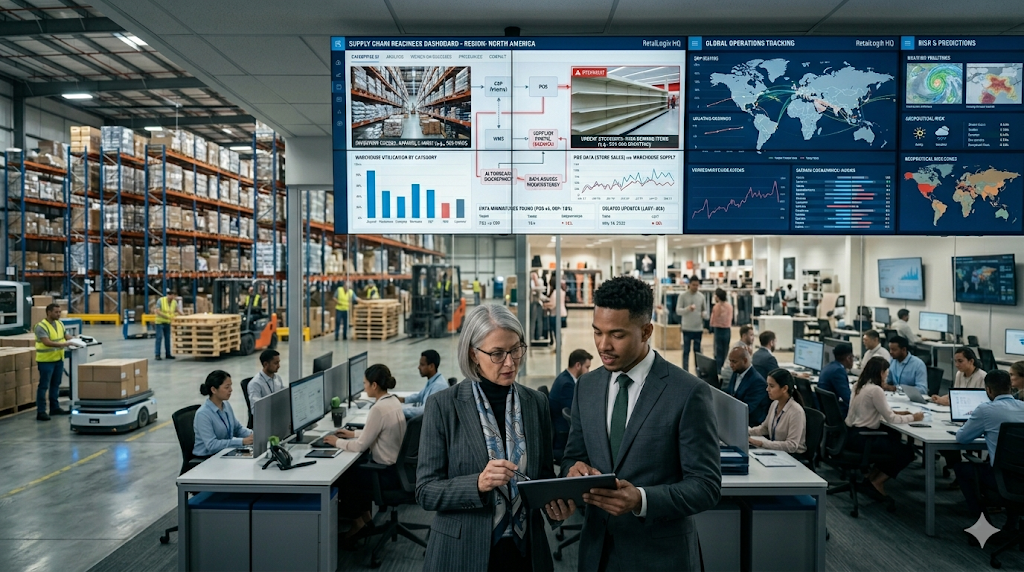
Retailers have spent millions on AI forecasting tools hoping to reduce stock problems and make better buying decisions. But many still struggle with the same issue: either too much inventory that customers do not want or too little of what they do.
The AI is running fine, but it cannot fix bad inputs. The problem is the quality of the data and decisions behind it.
The Real Problem Starts Before the Algorithm
When inventory problems occur, most retailers blame the forecasting model. But in most cases, that is not where the problem starts. The model can only work with the information it receives.
Retailers collect inventory data from many different systems, including ERP platforms, point-of-sale systems, warehouses, suppliers, and external market sources. The challenge is that these systems often operate separately. Some data updates every few hours, some overnight, and some only once a week. Teams also rely on spreadsheets that can become outdated almost immediately.
As a result, planners often make replenishment decisions using information that is already old or incomplete. A product may have one code in the warehouse system and another in the ordering system. A supplier may have changed delivery timelines weeks ago, but the old lead time still remains in the system.
The forecasting model treats all this information as accurate. If the data is outdated, or incomplete, the forecast will be incomplete too. The issue is not that the algorithm cannot predict demand. The issue is that it is making predictions based on information it cannot fully trust.
What Happens When the Problem Stays Unsolved
When retailers overstock, they tie up cash in products that are not selling. To move excess inventory, they often lower prices, which reduces margins. They also end up paying for additional storage and inventory handling.
When retailers understock, they miss potential sales and lose customers to competitors. They might also need to place urgent orders, which can increase costs.
Retailers use demand forecasts to plan budgets, negotiate supplier contracts, and make expansion decisions. When forecasts rely on outdated or unreliable data, every decision built on them becomes less reliable.
The challenge is that dashboards can still look accurate. Leaders see the numbers, but not always the data issues behind them. Teams may know there is a problem, but without better systems, the same mistakes keep repeating.
"Improving inventory forecasts starts with improving the data behind them — the model can only be as good as the information it receives."
Struggling with Inventory Accuracy?
Talk to Parkar about fixing the data foundation behind your AI forecasting.
What Actually Needs to Change
Improving inventory forecasts starts with improving the data behind them. Retailers need connected systems, so inventory, sales, warehouse, and supplier information stays consistent and up to date.
Each product should have one consistent record across the business. Supplier lead times should reflect actual delivery timelines, not outdated assumptions. Forecasting should also account for factors such as seasonality, regional demand, and promotions instead of relying on broad averages.
Most importantly, retailers need to compare forecasts with actual sales regularly. When real sales data feeds back into the forecasting process, teams can identify what is working correctly and what is not, and improve future decisions.
Where Parkar Has Done This Before
Parkar has worked with large retailers that manage products across multiple regions, channels, and warehouses. We have seen organisations where five systems contained five different versions of the same product record, supplier lead times had not been updated for months, and planners relied on week-old data because they could not access fresh information.
We rebuilt the data pipelines that connect these systems and established product data standards that work across regions. We have also integrated ERP, warehouse, and point-of-sale systems so planners can make decisions from a single, consistent view of the business. With time, we have seen that improving the model without fixing the underlying data does not deliver meaningful results.
Parkar is the AI Transformation Provider for the enterprise. AIONIQ is our framework, delivered through Discovery, Roadmap, Build, and Scale, supported by the AIONIQ Platform. We establish the AI-Ready Data Foundation before evaluating or deploying any forecasting model. By the time a client reaches Build, the data infrastructure is already in place, giving the model a foundation designed to support it.
Start With an AIONIQ Discovery
If your inventory performance has not improved despite significant AI investment, switching to another model is probably not the solution. The next step is to identify where the data breakdown happened.
AIONIQ Discovery is a five-day diagnostic that pinpoints data gaps, identifies the systems creating misalignment, and maps out a clear path forward. Instead of relying on assumptions, you get clear priorities, actionable insights, and a focused plan to improve results.
Get Clarity in 5 Days
Start with an AIONIQ Discovery diagnostic and identify exactly where your data is letting your AI down.